This is Part 9 in our series on AI-enabled automation in project management. Part 8 examined how AI is reshaping the project manager’s role.
The case for AI in project management used to be built on potential. As recently as late 2023, only about one in five project professionals reported using AI in their work, even as 82% of senior leaders expected AI to have an impact on their projects.
Now executives are ready to move past hype and see real-world results. Luckily, the measurable benefits of using AI in project management are rolling in. Here’s what they find.
1) Time Savings: A Day a Week, Redirected
The most immediate and widely reported benefit is time recovery. Administrative work has long consumed a disproportionate share of a manager’s week–nearly a full day per week according to McKinsey. When it comes to project management specifically, about half of organizations spent a day or more each month manually collating project reports as of 2021.
All this led Gartner to famously project (way back in 2019) that 80% of today’s project management work would be eliminated by AI by 2030.
And as the end of the decade closes in, that pronouncement is becoming more probable by the quarter. Nearly 60% of workers estimate automation could return six or more hours a week to them. In controlled tests, Microsoft found Copilot users caught up on a missed meeting nearly four times faster and completed search, summarization, and writing tasks 29% faster.
Project managers who have AI autonomously draft status reports, update timelines, and generate meeting summaries are reclaiming up to a day a week. For a discipline that runs on leadership bandwidth, that’s the difference between a week spent reacting and a week spent managing.

Teams that have adopted project management software with embedded automation describe the shift the way organizations describe moving from fully manual coordination to labor scheduling software: repetitive sequencing is handled by the system; humans are left to make the decisions that require judgment. The additional capacity this generates — for stakeholder alignment, for course correction, for vision-setting — is exactly the capacity that separates adequate execution from excellent delivery.
2) Productivity: Consistent Gains, Not Edge Cases
While the time savings of using AI get a lot of attention, it has also already led to more productive work.
KPMG found that companies investing in AI report an average of 15% productivity improvement on the projects they undertake. On the global scale, AI could aid a 40% increase in productivity by 2035, according to the World Economic Forum.
When it comes to project managers, 93% of AI trailblazers reported productivity gains as early as mid-2024. Capterra’s survey of 1,153 project managers using AI found 63% named productivity and efficiency as the top benefit, and 90% reported a positive return on their AI investment.
Project managers report anywhere from 60-70% productivity gains when using GenAI for data analysis, reviewing content, planning and monitoring, risk management, and cost management.
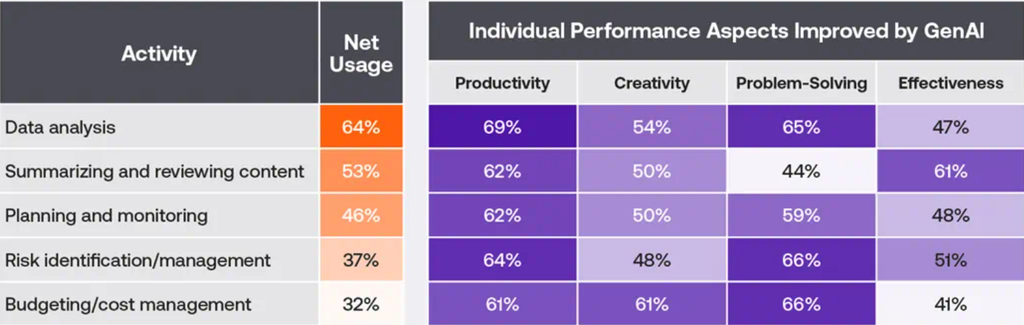
The mechanism is straightforward: AI continuously updates logs, refreshes dashboards, and monitors progress, giving teams real-time visibility without constant, manual check-ins. Those check-ins carry hidden costs, like the observer effect where the act of measuring changes the measure itself. Additionally, manually produced data generates the kind of uncertainty that misaligns expectations and quietly undermines output. When teams have live data surfaced automatically through their task management applications, that uncertainty collapses. Attention shifts from tracking to delivering.
3) Schedule and Cost Performance: Earlier Signals, Fewer Overruns
A third dimension where AI is improving project outcomes is by avoiding problems. Small variances, if ignored, compound. A one-week slip in February becomes a quarter-end delivery problem that nobody saw coming — until the forecasting tool flagged it in January. The stakes are high: a McKinsey–Oxford study of more than 5,400 IT projects found large projects run 45% over budget on average while delivering 56% less value than predicted.
By scanning patterns across historical project data — prior schedules, resource actuals, variance histories — AI’s predictive analytics capabilities flag conditions that precede problems before those problems arrive.

The practical effect of earlier signals shows up in the delivery numbers. PMI found AI innovators delivered 61% of projects on time versus 47% for laggards, and met or exceeded their ROI estimates on 64% of projects versus 52%. Among generative-AI users, 85% of heavy users report improvement in scheduling and 85% in cost management, versus 46% and 42% of light users. In schedule risk analysis specifically, machine-learning forecasts of activity durations on rail and oil-and-gas megaprojects proved at least twice as accurate as traditional quantitative schedule risk analysis, and could be rerun continuously rather than once or twice a year.
4) Decision-Making: Hours, Not Days
AI-assisted decision support compresses scenario analysis from days to hours, or even minutes.
Traditional quantitative schedule risk analysis is so labor-intensive that even risk-mature organizations only run it quarterly or twice a year. Once trained, AI models produce duration distributions in seconds. Project management software equipped with scenario modeling can simultaneously project the schedule impact of adding parallel capacity, the cost impact of de-scoping a feature, and the risk profile of re-sequencing tasks. This enables project managers to walk into any sponsor conversation with an analysis already in hand.
Additionally, managers previously had to navigate multiple systems and reconcile conflicting reports in order to get a clear timeline of project health. AI now enables performance dashboards that continuously update with live data. When paired with AI-powered risk scoring, these tools allow leaders to evaluate options with eyes open rather than with instinct alone.
5) Team Morale and Stakeholder Confidence: The Harder Metric

Many leaders fear how AI will be received by their existing workforce. While morale is a difficult benefit to quantify, adopting AI appears to actually consistently improve team morale.
According to a survey conducted by Microsoft and LinkedIn across 31 countries, “92% say AI makes their workload more manageable and 91% say they enjoy their work more.” Slack’s Workforce Index found daily AI users 81% more likely than non-users to report very good job satisfaction.
The underlying dynamic is not hard to understand: not only does AI reduce mundane, time-consuming and error prone tasks, AI-driven reminders, automated updates, and centralized visibility reduce the last-minute chaos and constant firefighting that erode team culture over time. It leads to fewer chase-downs, less scrambling for status, and more structured execution.
Stakeholders feel the effect too: Organizations that communicate effectively are five times more likely to be high performers. AI-generated summaries and real-time dashboards provide the kind of visibility that builds confidence — not because they tell a better story than the truth, but because they tell the truth faster and more legibly than manual reporting ever could.
The Pattern Across All Five Areas
The gains above — time, productivity, schedule reliability, decision quality, morale — are not independent effects. They are expressions of the same underlying shift: when project stakeholders and teams have accurate, current information and are freed from the overhead of producing it, projects become more predictable. Predictability reduces the run-on effects of small problems before they become costly ones. That is the real return on AI in project delivery.
Organizations that treat this as an either/or — technology or human leadership — miss the compounding effect. The data bears this out. PMI found heavy generative-AI users were ten times more likely to work for organizations that actively empower them to use it. AI sharpens the data; leaders use it. Neither works as well without the other.
WiserWulff has spent decades cultivating and identifying true leaders because we know that they are critical to projects success. Now we’re providing tools to help automate project process. Contact us to learn more about how we can create this powerful combination in your organization.